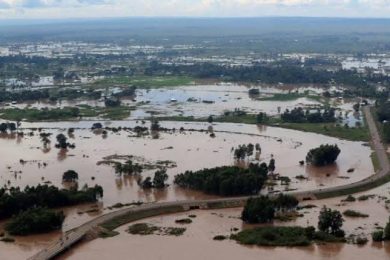
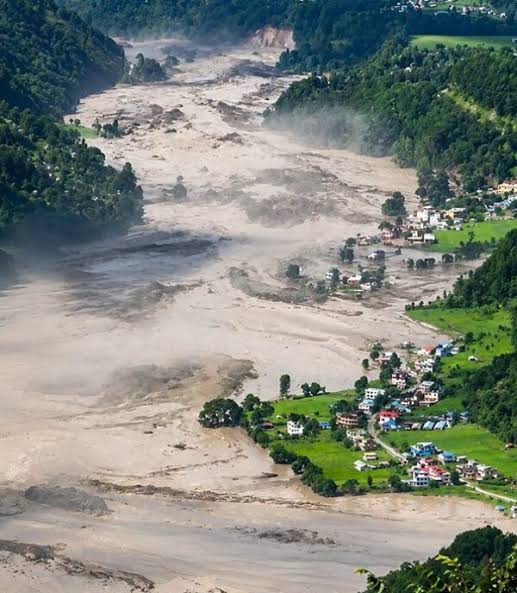
A glacial collapse in the Himalayas triggered catastrophic flash floods along the Nepal-China border killing at least 180 people and leaving more than 1,300 others missing as rescue teams searched for survivors across the mountainous region.
The disaster centered on Nepal’s Rasuwa and Nuwakot districts, including the trading hub of Syabrubesi on the border. On the Chinese side, Gyirong County in Tibet was hit.
The exact sequence of events is still unclear, but on Wednesday morning, torrents of water and debris crashed downstream on both sides of the border sweeping downstream communities after a large mass of ice and rock collapsed into the Lhende Khola river system.
Surveillance video from the Chinese side showed a wall of mud and water crashing over a building as terrified people ran away.
In Nepal, a surge of water hit villages and towns on the path of two rivers — Bhote Koshi and Trishuli.
The disaster was intially described as a flood on the Nepali side, and a mudslide by Chinese authorities.
The floods destroyed homes, roads and bridges, while cutting electricity and communications around the affected border areas. China has activated a Level-II emergency response for geological disasters and deployed rescue teams, while 111 additional firefighters have been sent to reinforce operations.
Chinese President Xi Jinping on Thursday ordered an all-out search for missing people, the evacuation of communities at risk and stronger monitoring and early-warning measures to prevent secondary disasters.
Climate researchers say the disaster demonstrates the complexity of flood hazards in high-mountain regions.
Liz Stephens, a professor at the University of Reading, said landslides, avalanches and glacial lake outburst floods can combine to produce sudden flooding that is difficult to predict. She also stressed that rapid information-sharing between countries is critical for early warning in transboundary river basins.
Nepal and China have agreed to exchange meteorological information following the disaster, according to Nepal’s Department of Hydrology and Meteorology.